

Everyone carries a private gallery of images for the books they love: the shade of a drawing room, the tilt of a protagonist’s hat, or the cadence of a favorite line of dialogue.
Great adaptations have to perform a delicate balancing act. Stay too faithful to the source material, and a story can feel stuck on the page. Stray too far, and you risk losing the original magic.
The challenge isn’t just copying a novel frame-for-frame. It’s a translation. The goal is to find the right look, energy, and performance to match the original text, preserving a book’s essence while embracing what television can do best.
When an adaptation succeeds, it achieves something remarkable: it becomes definitive. For readers and viewers looking for storytelling with real literary depth, these six essential shows are proof that classic books can find a powerful second life on screen.
Pride and Prejudice (1995): Tension Beneath Polite Conversation
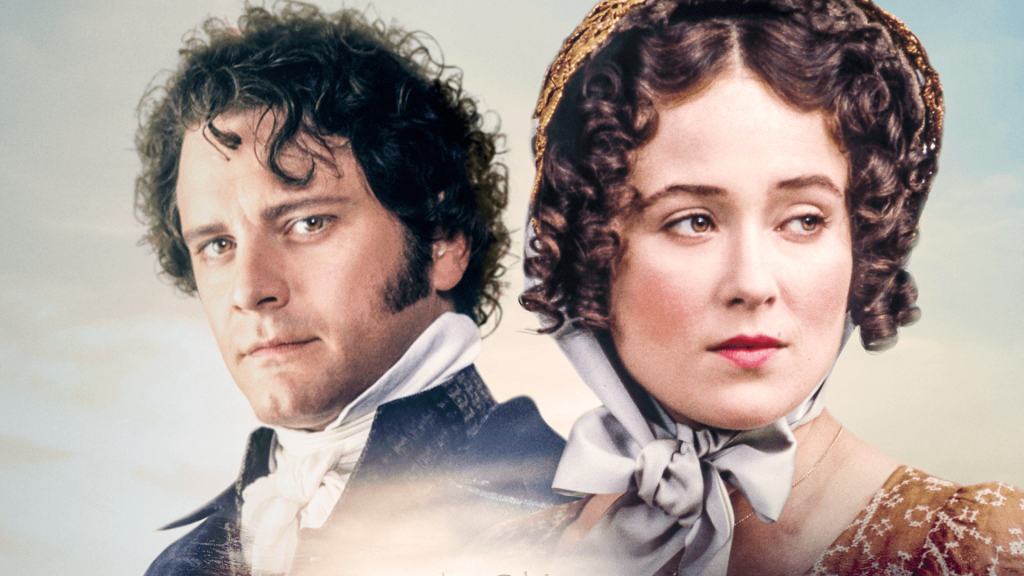
Few adaptations have entered the cultural imagination quite like the BBC’s Pride and Prejudice. Much of the immediate credit belongs to Jennifer Ehle and Colin Firth, whose magnetic chemistry transformed Jane Austen’s famous dynamic into one of television’s most enduring romances. Decades later, viewers are still swooning over that wet shirt lake scene—a moment that proved Jane Austen’s quiet social critique could generate internet-level thirst long before the internet existed.
What makes the adaptation so successful is its confidence. Writer Andrew Davies trusted Austen’s wit, intelligence, and emotional restraint rather than over-explaining her intentions. The script uses longing, misunderstandings, and strict social rules to build exquisite tension beneath polite conversation.
Brideshead Revisited (1981): The Elegance of Melancholy
While some series succeed through rapid momentum, Brideshead Revisited wins its audience through sheer patience. Adapted from Evelyn Waugh’s celebrated novel, the drama unfolds with remarkable poise, creating a rich world that allows viewers to truly inhabit the setting.
Jeremy Irons anchors the production as Charles Ryder, guiding the audience through a sweeping story where class, faith, and memory are given room to breathe. Few productions have ever captured the bittersweet sensation of looking back on a vanished world with such seasoned melancholy.
Bleak House (2005): Modern Pacing for Classic Dickens
Charles Dickens is famous for sprawling narratives, endless subplots, and enormous casts of characters. The 2005 adaptation of Bleak House solved that storytelling challenge by leaning directly into the strengths of television.
The show adopts a brisk, half-hour serialized format, mirroring the addictive suspense of modern dramas to make a 19th-century story feel unexpectedly urgent. Featuring a standout performance by Gillian Anderson, the story’s legal entanglements and dark mysteries gain incredible momentum, turning a Victorian court case that drags on for generations into a surprising thriller.
Wolf Hall: The Dramatic Power of a Glance
Adapting Hilary Mantel’s celebrated historical novels for the screen was always going to be a challenge. Much of the original books’ brilliance lives directly inside Thomas Cromwell’s head, relying on his quiet observations to drive the narrative.
Writer Peter Straughan and director Peter Kosminsky smartly solved this problem with exquisite restraint. Dialogue is kept sparse and explanations are kept to a minimum as the script places immense trust in its audience. At the center is Mark Rylance as Cromwell. Watchful and endlessly intelligent, Rylance turns the simple act of listening into high-stakes drama.
Jane Eyre (2006): Embracing the Gothic Darkness
The challenge of adapting Jane Eyre lies in balancing all of its moving parts without losing its core emotional intensity. Charlotte Brontë’s masterpiece is a complex narrative: part sweeping romance, part haunting Gothic mystery, and part coming-of-age story.
The 2006 adaptation succeeds by understanding and honoring every dimension of Brontë’s writing at once. Ruth Wilson captures Jane’s fierce resolve, while Toby Stephens brings a compelling volatility to Rochester. It fully embraces the Gothic spirit: moody moors, locked attics, and men whose idea of flirting is lingering mysteriously in doorways.
Tinker Tailor Soldier Spy (1979): The Significance of Understatement
Not all great literary adaptations require grand country estates or lavish ballrooms. Adapted from John le Carré’s landmark espionage novel, Tinker Tailor Soldier Spy remains one of the most influential spy dramas ever brought to television.
At the center is Alec Guinness as George Smiley, a spymaster who solves complex puzzles through patience rather than explosive fistfights. What makes this adaptation endure is its deep trust in complexity. The script deliberately withholds information, forcing you to pay close attention to every whispered conversation.
These adaptations understand that great literature cannot simply be copied frame-for-frame onto a screen—it must be translated into a brand-new medium.
That creative translation is where the magic lives: in a performance that permanently fuses an actor to a character, a director who uncovers a fresh layer of meaning, or a script that captures the true spirit of a novel. They don’t just move a story from page to screen; they find a whole new life there.