


Few modern screen actors can alter the pressure of a scene as instantly or effortlessly as David Tennant.
Over the last two decades, he has become a defining force across British television, grounding everything from blockbuster science fiction to bleak coastal procedurals with magnetic energy.
Many viewers notice his expressive charisma. But the real key to his longevity is a classical discipline learned during his formative years with the Royal Shakespeare Company: he always starts with the script. Rather than imposing a fixed star persona onto every character, Tennant approaches his roles as a master interpreter. It is a welcome reminder that the most captivating performances aren’t just layered on top of the writing, but are built from within it.
Restraint: The Engine of Tennant’s Power
Frequently praised for his intensity, Tennant’s true talent lies in the careful calculation beneath it. You will rarely see an unearned emotional peak or an abrupt explosion in his work. Instead, his best moments are the result of slow accumulation—a clipped sentence here, an avoided glance there—as he quietly builds a complete character landscape.
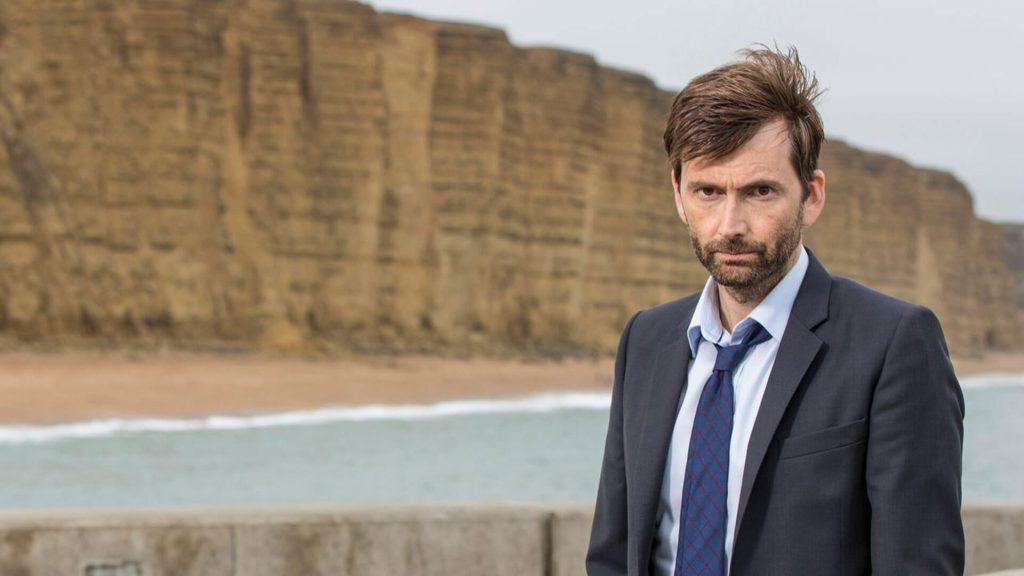
Take Broadchurch. As DI Alec Hardy (David Tennant) investigating a small-town murder alongside DS Ellie Miller (Olivia Colman, The Crown), Tennant gives a brooding performance anchored by heavy silences and sharp hesitations. Hardy radiates physical exhaustion and endless frustration, mostly directed at his own failing heart and the sheer inconvenience of local town gossip. Yet by obsessively pacing the performance, Tennant allows the story’s tension to simmer naturally.
Contrast that with his chilling turn as real-life serial killer Dennis Nilsen in Des. Tennant adopts a flat, terrifying stillness. Almost entirely devoid of standard theatrical emotion, his performance becomes deeply unsettling precisely because it refuses to show off. He knows exactly when to step back and let the script do the heavy lifting.
The Physicality of Prose: Body Language as Dialogue
Confronted by scripts that demand more stylized energy, Tennant rarely abandons his text-first Royal Shakespeare Company discipline; he simply translates the prose into physical motion.
Good Omens puts this adaptability on full display. As the demon Crowley, Tennant uses his body to literalize Neil Gaiman and Terry Pratchett’s irreverent prose, slithering through scenes with a physical looseness—and an alarming reliance on tight leather trousers—that perfectly mirrors the dialogue’s rhythmic wit. In a single beat, a swaggering joke pivots into a quiet confession before snapping into sudden panic.
This interpretive skill is also why his tenure on Doctor Who set a new benchmark for the modern show. Showrunner Russell T. Davies (It’s a Sin) wrote rapid-fire, emotionally volatile scripts that could have been played as mere populist escapism. Instead, Tennant treated the material with the emotional precision of classical tragedy, matching the show’s breathless velocity while keeping alien concepts grounded in genuine human stakes.
The Art of Listening
Despite his formidable screen presence, Tennant rarely steals focus from his scene partners. It’s part of a quintessentially British theatrical discipline: the ability to listen just as intensely as he speaks.
Tennant understands that a script’s momentum is a team effort. Reactive acting often finds him at his very best, whether trading irritable banter with Colman in Broadchurch or bickering over centuries-old theology with Aziraphale (Michael Sheen, Quiz) in Good Omens. Rather than dominating the room, he allows his co-stars to shape his posture, timing, and tone.
By listening with his whole body, his technique supports the on-screen chemistry rather than overpowering it. Scenes feel organic, lively, and genuinely collaborative as a result.
The Master Interpreter
Ultimately, David Tennant’s gift comes down to a deep respect for the mechanics of storytelling. He possesses an instinct for where tension should accumulate and how a subtle shift in dialogue can alter an entire scene.
He inhabits the material, whether solving a murder in a quiet coastal town or traveling the universe in a blue box.
By trusting the script, David Tennant conveniences us to trust him—whether he is saving the world or just trying to get through one last interrogation.