

You could go out tonight. Or you could spend the evening in a Manchester living room, travel between two chaotic families in Essex and Wales, wander through an English field, visit an eccentric village, or step inside the homes of London’s East End.
It is one of the peculiar pleasures of British television: making a tiny world feel big enough to get lost in for an evening.
The best BBC shows understand that great television doesn’t have to expand the map. Sometimes a single family, a friendship, a village, or even an armchair contains everything a great night of television needs, demonstrating that you don’t have to go very far to find somewhere worth staying.
The Royle Family: The Living Room Sanctuary
How much television can you make from a family sitting around watching television? Quite a lot, as it turns out.
The Royle Family strips the sitcom down to its domestic essentials. Created by and starring Caroline Aherne (The Mrs Merton Show) alongside Ricky Tomlinson (Cracker), the show unfolds almost entirely inside the Royles’ Manchester living room. Jim, Barbara, Denise, and Antony talk, argue, eat, gossip, and watch the telly.
With Jim Royle ruling his armchair like a monarch defending a fortress, the family itself provides more than enough material. Spend enough time in that room and tiny details become significant: a familiar complaint becomes a ritual, and a glance across the tea table delivers the punchline.
Gavin & Stacey: The Extended Family
A romance brings Gavin and Stacey together, but two families make us want to stick around.
Connecting Billericay in Essex with Barry in South Wales, the show introduces a collection of characters created by Ruth Jones (Stella) and James Corden (The Wrong Mans) who quickly become just as important as the couple at the center. Between Smithy, Nessa, Pam, Mick, and Uncle Bryn, simply putting these people in a room together is an event.
Whether Uncle Bryn is treating a basic GPS navigation system like a miracle of modern science or Pam is overreacting to a minor catering hitch, the show’s pleasure is intimate. Kitchens, family cars, and ordinary conversations become the places where the biggest laughs happen.
Detectorists: The Quiet Countryside
Two friends walk through a field looking for buried metal. It doesn’t sound like much, which is precisely why Detectorists is so special.
Written and directed by Mackenzie Crook (The Office), who stars alongside Toby Jones (Mr Bates vs The Post Office), the show follows Andy and Lance as they wander the Essex countryside. They spend hours searching for history beneath their feet—which usually results in a collection of rusted ring-pulls and discarded farm machinery—but what they’re really doing is keeping each other company.
The show finds meaning in friendship, quiet conversations, and changing seasons. Give two friends a field and enough time together, and an afternoon of doing almost nothing feels like more than enough.
The Vicar of Dibley: The Eccentric Village
Dibley isn’t a large village, but it contains more than enough personality for a television show.
When Geraldine Granger (Dawn French, French and Saunders) arrives as the new vicar, she finds herself surrounded by local eccentrics whose parish council meetings routinely devolve into heated debates over jam-making protocols and butter-to-bread ratios. The comedy comes from their habits, their misunderstandings, and the unavoidable fact that village life keeps bringing everybody back together.
The village council meetings, homes, and parish church create a complete little world with its own rhythms. Geraldine doesn’t merely work there; she gradually becomes part of the community, offering a warm welcome the moment an episode begins.
Call the Midwife: History at Ground Level
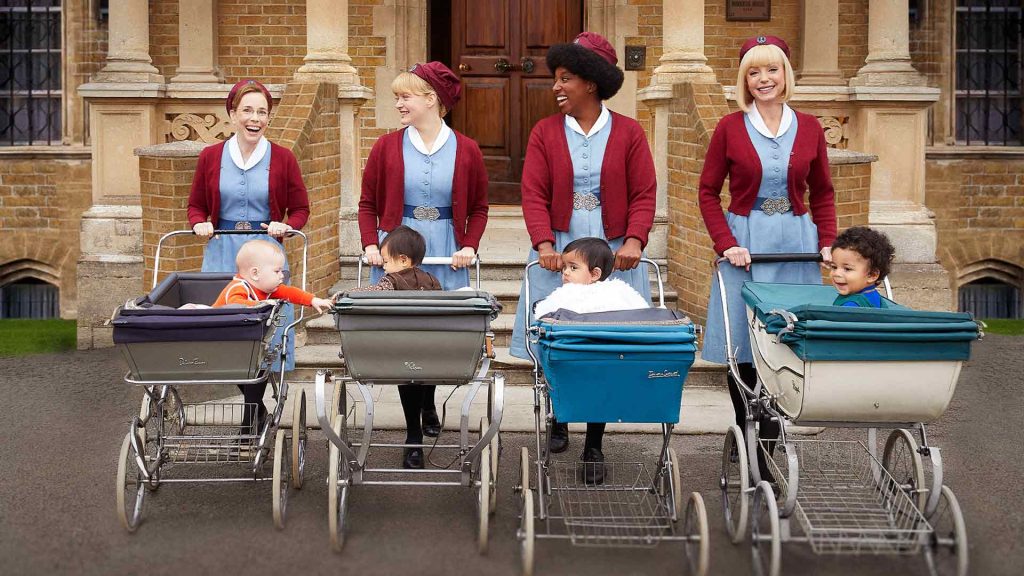
Small stories can contain enormous history. In Call the Midwife, big historical shifts arrive at the front door as we follow the midwives and nuns of Nonnatus House caring for families in 1950s East London.
Starring Sister Julienne (Jenny Agutter, The Railway Children), the show encompasses huge subjects: poverty, medicine, class, faith, and changing social attitudes. Yet those monumental shifts rarely arrive as abstractions; they arrive through personal, human stories.
Focusing on one street, one family, or one birth allows us to understand something much larger, keeping the scale human even when the implications reach far beyond Poplar.
Sherlock: The Famous Address
Of course, a night in doesn’t always have to be quiet. Sherlock gives the BBC’s talent for intimate storytelling a jolt of adrenaline.
The mysteries stretch across London, featuring dangerous adversaries and feats of deduction by Sherlock Holmes (Benedict Cumberbatch, The Power of the Dog) and John Watson (Martin Freeman, The Responder). But for all that scale, the heart of the show remains compact: two men, one friendship, and 221B Baker Street.
Amid the clutter of violin cases, skull decorations, and half-finished experiments, Baker Street gives them somewhere to return to after every extraordinary case. The outside world can get as complicated as it likes, but the show always comes back to the room.
After all, the best seat in the house is often your own.