


Christmas may be the only time of year when spending several consecutive days under the same roof as your entire extended family is considered a good idea. Agatha Christie, naturally, saw the lethal possibilities.
In Hercule Poirot’s Christmas, wealthy patriarch Simeon Lee summons his scattered family to Gorston Hall for the holidays. What follows brings together children, spouses, financial dependencies, and enough unresolved resentment to make Christmas dinner uncomfortable long before anyone gets murdered.
It is an ideal setup for a country-house mystery because the holiday does much of the detective’s heavy lifting. Christmas brings people home, resurrecting old rivalries and forcing relatives who might happily avoid one another for the rest of the year to sit around the same table and perform family harmony.
Christie simply adds a body, and the feature-length adaptation of Agatha Christie’s Poirot understands how much fun lies inside that premise.
Christmas at Gorston Hall
At the center of the story is Simeon Lee, a formidable patriarch who summons his family to Gorston Hall for the holidays. This is not necessarily good news for his children. Simeon has spent a lifetime accumulating wealth, power, and complicated relationships, and his relatives arrive bringing years of accumulated resentment.
When Simeon mischievously announces surprise plans concerning his will, the holiday atmosphere deteriorates rapidly. His subsequent murder inside a locked room transforms the festive family gathering into a high-stakes suspect list.
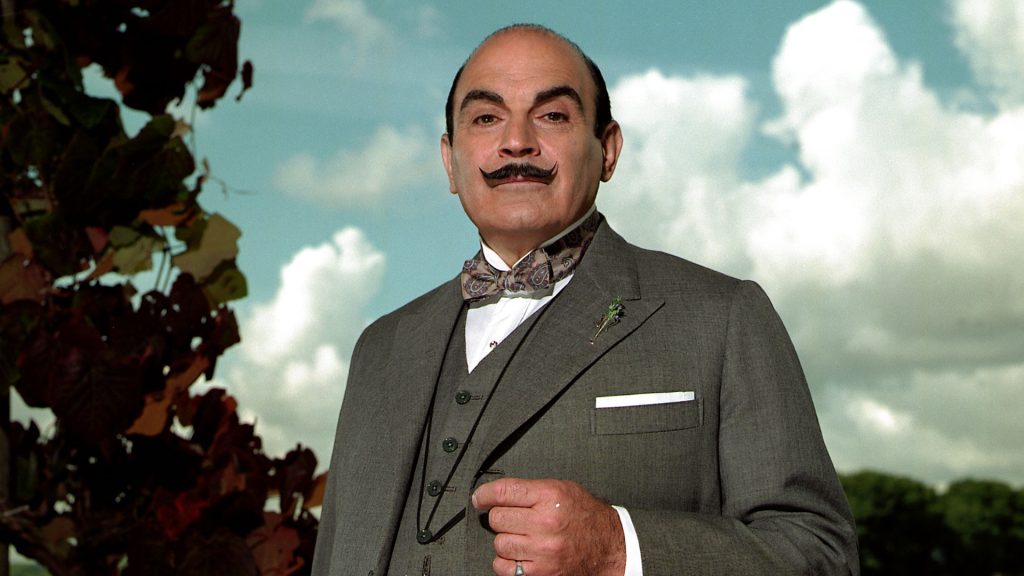
Fortunately, Hercule Poirot (David Suchet, Press) is already nearby. Joined by Chief Inspector Japp (Philip Jackson, Raised by Wolves), he sets out to determine what happened behind that locked door, finding plenty of motives to investigate.
Why Christmas Makes the Ideal Setting
Agatha Christie understood something useful about the holidays: people spend Christmas with family whether or not it is a good idea. That dynamic makes the season ideal for a closed-circle mystery.
Ordinarily, relatives carrying decades of resentment might avoid one another, but Christmas provides a socially acceptable reason to gather under one roof. Everyone arrives with history: parents and children resume old roles, siblings recall old rivalries, and money complicates affection.
The murder doesn’t destroy a happy family Christmas; it exposes the fact that the holiday was already a performance. Good manners frequently conceal bad feelings, and Christie knows precisely where to look.
Meet the Suspects
One of the great pleasures of the episode is meeting a room full of suspects and determining which one is capable of murder. Gorston Hall offers a rich collection: Simeon’s children have different reasons to resent him, their spouses bring extra layers of tension, and an unexpected granddaughter arriving from overseas adds new secrets to the mix.
Simeon takes deliberate pleasure in provoking everyone, ensuring that by the time the crime occurs, motives are in generous supply.
Rather than simply waiting for Poirot to reveal the solution, the audience is invited to study everyone in the room. We are encouraged to weigh who stands to inherit, who is concealing a past secret, and what really occurred behind that locked door.
Order vs. Family Chaos
David Suchet’s Poirot is uniquely suited to this environment because his character embodies such meticulous order. His clothes are immaculate, his manners are precise, his thinking is methodical, and his mustache is groomed to perfection.
Drop him inside a country house filled with emotional disorder, conflicting stories, and family feuds, and the contrast becomes pure entertainment. Watching Poirot methodically sift through family grievances while keeping his tailored suits pristine creates a quiet, simmering tension.
Poirot doesn’t need to overpower the suspects; he simply observes. A nervous reaction, a contradiction, or a suspicious lapse in memory matters far more than physical clues.
The Country-House Aesthetic
Visually, Hercule Poirot’s Christmas delivers all the essential ingredients of a festive British mystery. Filmed around Chilham Castle and its Kent village, Gorston Hall provides a grand setting packed with period clothes, roaring fireplaces, and Christmas decorations.
The cozy aesthetic matters because there is a peculiar pleasure in watching terrible things happen somewhere that looks so inviting. The safer the setting appears on the surface, the more satisfying it becomes to discover the danger hiding inside.
A Seasonal Mystery Worth Returning To
Hercule Poirot’s Christmas doesn’t merely take a standard detective story and hang decorations around it: the holiday creates the exact conditions the mystery requires.
Christmas gathers a family that might otherwise remain scattered, allowing old grievances to return and transforming a household into evidence. Meanwhile, the feature-length episode gives us so much of what makes classic TV Poirot work—Suchet’s sharp performance, an imposing house, buried secrets, and a solution waiting inside the little grey cells.
It is a chilling reminder that the most dangerous secrets are often the ones kept in the family.